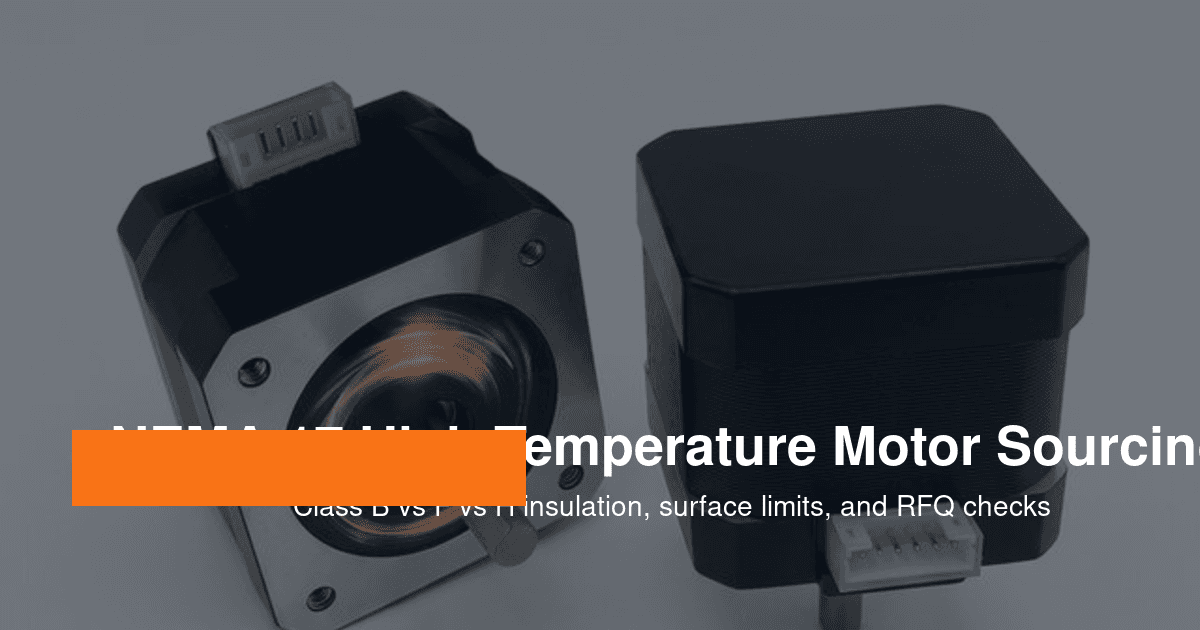
NEMA 17 Insulation Classes: A High-Temperature Sourcing Guide
A procurement and engineering guide to understanding NEMA 17 stepper motor temperature ratings, Class B vs. Class H, and how to source motors for high-heat environments.
Content Integrity Note
- Author: Jimmy Su
- Published: 2026/06/24
- Basis: Factory-side NEMA 17 OEM communication and validation workflows.
- Boundary: Final model and parameter decisions should be validated in your own system tests.
When standard NEMA 17 stepper motors fail in the field, thermal stress is often the hidden culprit. As engineers push stepper motors into increasingly challenging enclosed environments—like high-temperature 3D printers, enclosed automated testing cells, and specialized industrial ovens—procurement teams must upgrade their specifications from standard "Class B" materials to high-temperature variants.
This guide breaks down NEMA 17 insulation classes, thermal limits, the physical impact of heat on stepper performance, and exactly how to structure your RFQ to prevent catastrophic overheating failures during volume production. Whether you are an engineer designing the next generation of CoreXY 3D printers or a supply chain manager sourcing thousands of axes per month, understanding these thermal guardrails will save you from costly product recalls and assembly line downtime.
Scope and limitation: This article applies to 42 mm hybrid NEMA 17 stepper motors used in global OEM sourcing programs, especially enclosed printers, test equipment, cabinets, and compact automation. It does not replace a supplier datasheet or a lab thermal rise test; final approval still requires sample validation at your real ambient temperature, current setting, mounting bracket, and duty cycle.
The Core Thermal Rule: Surface vs. Winding Temperature
Before comparing specific insulation classes, buyers and engineers must understand one critical thermal relationship that dictates all stepper motor reliability: The temperature you measure on the motor's external casing is never the temperature of the internal copper windings.
As a general engineering rule of thumb, the surface casing temperature of a NEMA 17 motor is approximately 30°C lower than its internal winding temperature. If your thermal camera or thermocouple reads a surface temperature of 90°C on the stator laminations, the internal enameled coils are likely approaching 120°C.
For standard motors, operating constantly near the thermal ceiling sets off a chain reaction of degradation:
- Wire Enamel Breakdown: The thin insulation layer on the copper wire turns brittle and eventually shorts across phases.
- Magnet Demagnetization: Standard Neodymium magnets permanently lose their magnetic flux density at elevated temperatures, permanently reducing the motor's holding torque even after it cools down.
- Bearing Grease Evaporation: Standard lithium-based bearing grease separates and evaporates, leading to mechanical friction, audible grinding noises, and sudden mechanical lock-ups.
Deep Dive into NEMA 17 Insulation Classes
The National Electrical Manufacturers Association (NEMA) standardizes motor sizes, but insulation ratings are dictated by global electrotechnical standards (IEC/NEMA). These classes define the absolute maximum temperature the motor's insulating materials can withstand for a sustained period without breaking down.
Most off-the-shelf NEMA 17 motors are manufactured to Class B specifications. Upgrading to Class F or Class H increases the motor's unit cost due to the requirement for more expensive adhesives, resins, and magnet materials, but dramatically improves reliability in harsh environments.
| Insulation Class | Max Internal Temperature | Max Safe Surface Temp (Est.) | Typical NEMA 17 Application | Component Upgrades Required | Relative Cost Impact |
|---|---|---|---|---|---|
| Class A | 105°C | 75°C | Legacy low-power equipment (Rarely specified in modern builds) | Standard enameled wire, standard bearings | Baseline |
| Class E | 120°C | 90°C | Older or cost-sensitive compact equipment with light duty cycles. | Improved enamel over Class A, still limited thermal margin | Low |
| Class B | 130°C | 100°C | Standard. Open-air 3D printers, desktop CNC routers, basic automation. | Standard materials, NdFeB magnets | Standard |
| Class F | 155°C | 125°C | Upgraded standard. Moderate enclosures, long continuous duty cycles. | Upgraded wire resin, high-temp synthetic grease | + 10-15% |
| Class H | 180°C | 150°C | High-Temp. Heated 3D printer chambers (e.g., Voron/RatRig), industrial ovens, sealed robotics. | SmCo magnets, pure PTFE wiring, ultra-high temp bearing grease | + 30-50% |
| Class C | > 200°C | > 170°C | Extreme industrial, aerospace, specialized scientific instruments. | Ceramic insulation, custom machining, no internal electronics | Custom Pricing |
Note: The "Max Safe Surface Temp" assumes the standard 30°C delta. Always refer to your specific motor's datasheet for exact casing limits, as potting materials and heatsinks can alter the delta.
Understanding the Physical Impact of Heat on Motor Life
Why exactly does a motor die when it gets too hot? The failure mechanism is rarely immediate. Instead, heat causes insidious, long-term degradation across multiple sub-components of the stepper motor assembly. Understanding these mechanisms is crucial for root cause analysis during field returns.
1. The Wire Insulation (Enameled Coating)
The primary determinant of the insulation class is the thin layer of enamel coating the copper windings. Under excessive heat, this enamel becomes brittle, cracks, and flakes off. When two exposed copper wires touch, a short circuit occurs within the phase. This drastically drops the coil resistance, pulling an enormous spike of current from the stepper driver, often instantly destroying the driver's MOSFETs. This is why a burned-out motor often takes the controller board down with it.
2. Permanent Magnet Degradation
NEMA 17 hybrid stepper motors rely on strong permanent magnets in the rotor. Standard motors use Neodymium Iron Boron (NdFeB) magnets, which offer incredibly high flux density at room temperature. However, standard grade NdFeB has a relatively low Curie temperature. As the internal temperature climbs past 80°C to 100°C, these magnets begin to temporarily lose strength, reducing your holding and running torque. Worse, if the temperature exceeds the magnet's absolute maximum operating temperature (often around 120°C for standard grades), the magnet undergoes irreversible demagnetization. Even after the motor cools down to room temperature, it will never produce its original rated torque again. High-temperature Class H motors mitigate this by using high-temperature grade Neodymium (e.g., UH or EH grades) or entirely switching to Samarium Cobalt (SmCo) magnets, which handle heat beautifully but are more brittle and expensive.
3. Bearing Grease Failure
Stepper motors typically use deep groove ball bearings packed with a specific volume of grease. Standard lithium soap greases start to separate into base oil and thickener as temperatures exceed 100°C. The oil leaks out (often visible as a greasy residue on the motor shaft), leaving behind dry thickener that offers zero lubrication. Once the bearing runs dry, friction increases exponentially, generating even more heat until the bearing seizes entirely. Class F and Class H motors use specialized synthetic greases (like specific grades of Krytox or high-temp polyurea greases) designed to remain stable up to 200°C.
Case Study: Enclosed CoreXY 3D Printer Thermal Failure
To illustrate the real-world impact of ignoring insulation classes, consider the boom in enclosed, high-speed CoreXY 3D printers (such as the Voron or RatRig platforms) used for printing engineering polymers like ABS and Polycarbonate.
A common design error involves porting an open-air motion system design directly into a heated enclosure:
- The Setup: A standard Class B NEMA 17 motor is mounted inside a sealed printing chamber. The motor is driven at 1.5 Amps to achieve high acceleration.
- The Environment: The chamber is actively heated to 70°C to prevent the ABS plastic from warping.
- The Thermal Reality: A motor driven at 1.5A might generate a 60°C temperature rise above ambient due to copper and iron losses.
- The Failure: 70°C ambient + 60°C internal rise = 130°C internal winding temperature. The motor is operating exactly at its absolute Class B survival limit during every single print. Within weeks, users report layer shifting (due to lost torque from hot magnets), followed by a complete axis stall as the bearing grease evaporates.
By simply specifying a Class H motor during the BOM creation phase, the thermal ceiling moves to 180°C. Even at a 130°C internal operating temperature, the Class H motor retains a massive 50°C safety buffer, ensuring years of reliable operation without missed steps or bearing seizures.
Application Boundaries: When to Upgrade
Specifying a high-temperature motor is not just about checking a box on a datasheet. It requires a holistic understanding of your machine's environment and duty cycle.
🔴 When Standard (Class B) Fails
Do not use standard Class B motors if any of the following apply:
- High Ambient Temperature: The ambient environmental temperature surrounding the motor exceeds 50°C. Remember, a motor running at a safe 80°C rise above ambient will hit 130°C if the room itself is 50°C.
- Sealed Enclosures: The motor is installed inside a sealed, unventilated electrical cabinet or machine housing where self-heating will compound. Without airflow, the localized ambient temperature will continually rise.
- Aggressive Duty Cycles: The equipment will run continuous 24/7 cycles near its maximum current limit with no standstill periods for the motor to shed heat.
- Proximity to Radiators: The motor is mounted directly adjacent to heating elements, extruders, heated build plates, or uninsulated fluid pipes.
🟢 When High-Temp (Class H) is Strictly Required
You must specify Class H when:
- Heated Chamber 3D Printers: You are designing engineering-grade 3D printers that print ABS, PC, or PEEK, requiring active chamber temperatures of 60°C to 90°C. The motor must survive both the chamber heat and its own self-generated heat.
- Automotive and Under-Hood Testing: Applications that simulate or operate in engine bays where ambient temperatures regularly spike.
- Harsh Industrial Automation: Motors located near furnaces, drying ovens, or high-temperature washdown zones in food processing facilities.
- Zero-Maintenance Aerospace/Medical: Applications where reliability is paramount, active cooling (fans/heatsinks) is impossible due to space or sterility constraints, and the cost of a motor failure far exceeds the BOM cost.
High-Temperature Sourcing & RFQ Checklist
When moving a prototype into mass production, procurement teams must enforce strict specifications to ensure the supplier doesn't substitute standard components to save pennies. Using "high temp" in an email is not enough. Use this precise 6-point checklist in your formal Request for Quotation (RFQ), then attach the broader buyer fields from our NEMA 17 OEM RFQ checklist:
- 1. Explicitly Specify Insulation Class: Request Class F (155°C) or Class H (180°C) insulation directly in the RFQ document. Do not accept vague marketing terms.
- 2. Define Ambient Operating Temperature: State the maximum ambient temperature the motor will operate in. Example: "Motor must operate continuously in a 75°C ambient environment."
- 3. Confirm Magnet Material Grade: For Class H motors operating near 150°C, verify if the supplier is using high-grade Neodymium (e.g., N35EH) or Samarium Cobalt (SmCo) magnets. Ensure the supplier provides the demagnetization curve to prove holding torque at operating temperature.
- 4. Validate Bearing Grease Specifications: Request the exact brand and model of the bearing grease, and demand confirmation that it is rated for high-temperature continuous use (e.g., "Must use synthetic grease rated for > 150°C").
- 5. Request High-Temp Torque-Speed Curves: Because torque naturally drops as temperature rises, a room-temperature torque curve is useless for high-heat validation. Demand a dynamic torque-speed curve tested at your target operating temperature.
- 6. Lead Wire Material: Standard PVC wires melt at 80°C-105°C. Ensure the lead wires are specified as PTFE (Teflon) or silicone-insulated, which can easily withstand 200°C+.
Mitigating Risk: Thermal Management Strategies
If upgrading an entire machine fleet to Class H motors breaks the project's BOM budget, engineers can employ several system-level strategies to mitigate thermal risk on standard or Class F motors:
1. Optimize and Tune Driver Current
As detailed in our Driver Matching Guide, running a motor at 100% of its rated current is rarely necessary. Torque generation is roughly proportional to current, but heat generation (I²R copper losses) increases exponentially. Dropping your driver current by just 20% can slash heat generation by nearly 35% while still providing adequate torque for many applications.
2. Implement Standby Current Reduction
Modern stepper drivers (like TMC2209 or advanced digital drivers) have a standby current feature. Configure the driver to drop the current to 30% or 50% automatically when the motor is holding a static position. This gives the motor vital "cooldown" windows during the machine cycle.
3. Active and Passive Cooling
- Passive Cooling: Add extruded aluminum heatsinks to the NEMA 17 casing. Attach them with thermally conductive adhesive pads to increase the dissipating surface area.
- Active Cooling: If space permits, point a small 40mm cooling fan directly at the motor casing. Even minimal airflow breaks the boundary layer of stagnant hot air around the motor, drastically reducing its surface temperature.
- Mounting Heatsinks: The motor's front faceplate acts as its primary thermal pathway. Mount the motor to a large, thick aluminum bracket rather than plastic or carbon fiber. The aluminum chassis will act as a massive heatsink, drawing heat out of the motor face.
Final Validation Workflow for Procurement
Before approving a high-temperature NEMA 17 motor for mass production, run this simple physical validation test:
- Mount the sample motor in the actual machine enclosure.
- Load the machine with its heaviest, most aggressive toolpath or duty cycle.
- Bring the ambient environment to its maximum rated temperature.
- Run the cycle continuously for at least 4 hours (until thermal equilibrium is reached).
- Measure the external casing temperature using an infrared thermometer or thermocouple. If the casing exceeds 100°C for a Class B, 125°C for a Class F, or 150°C for a Class H, the system fails validation. You must either reduce the load, improve cooling, or upgrade the motor class.
Frequently Asked Questions (FAQ)
Does upgrading the insulation class affect the motor's holding torque?
Directly, the insulation itself does not change the torque output. However, high-temperature motors often use different permanent magnets (like SmCo instead of standard NdFeB) to survive the extreme heat. These alternative magnets have different magnetic properties, which can slightly alter the torque curve. Always request a specific high-temp torque curve from the supplier rather than relying on a standard datasheet.
What is the standard insulation class for a NEMA 17 motor?
The vast majority of standard off-the-shelf NEMA 17 stepper motors use Class B insulation, which is rated for a maximum internal winding temperature of 130°C.
How hot can a NEMA 17 motor get on the outside before it's dangerous?
As a rule of thumb, the surface temperature is typically 30°C cooler than the internal winding temperature. For a standard Class B motor, surface temperatures around 80°C to 100°C are generally the safe upper limit, though keeping it under 70°C is highly preferred for bearing grease longevity and overall safety.
When should procurement explicitly specify a Class H motor instead of Class F?
Evaluate Class F or Class H once local ambient temperature around the motor exceeds 50°C. Specify Class H (180°C limit) when the ambient environment reaches 60°C to 90°C, such as inside aggressively heated 3D printer enclosures, or when the motor must sit adjacent to extreme heat sources like fluid heaters, where a Class F motor would still lack sufficient thermal headroom.
Can I just use high-temperature wire and keep the standard motor?
No. While standard PVC wire will melt in high heat, upgrading only the wire to PTFE does not protect the internal enameled coils, the magnets, or the bearing grease. A true high-temperature motor upgrade requires a holistic change of internal materials.
Sourcing Support and Custom Engineering
Navigating the complexities of thermal derating and magnet selection doesn't have to stall your engineering timeline. If your project requires a NEMA 17 stepper motor capable of surviving a 150°C or 180°C internal environment, we can customize the insulation, magnets, bearing grease, and wiring to match your exact thermal profile without over-engineering the cost.
Email [email protected] with your target ambient temperature, physical space constraints, and duty cycle. Our engineering team will analyze the thermal load and propose the most cost-effective solution—whether that's a heavily optimized Class F build or a ruggedized Class H powerhouse—in a single technical cycle.
Sources & References
- Drives and Automation, NEMA insulation classes for motors — insulation class temperature limits and the surface-versus-winding temperature approximation.
- MOONS' Industries, stepper motor temperature rise test introduction — stepper-motor temperature-rise method and Class B winding/surface temperature guidance.
- StepperOnline, NEMA 17 high-temperature stepper motor, Class H 180°C — market example of a Class H NEMA 17 specification.
- SKF, LGHP 2 high-performance, high-temperature bearing grease — electric-motor bearing grease example for elevated operating temperatures.
Author

Jimmy Su
Export sales and application advisor for NEMA17Motor, focusing on OEM communication, technical alignment, and production handoff.
Categories
More Posts
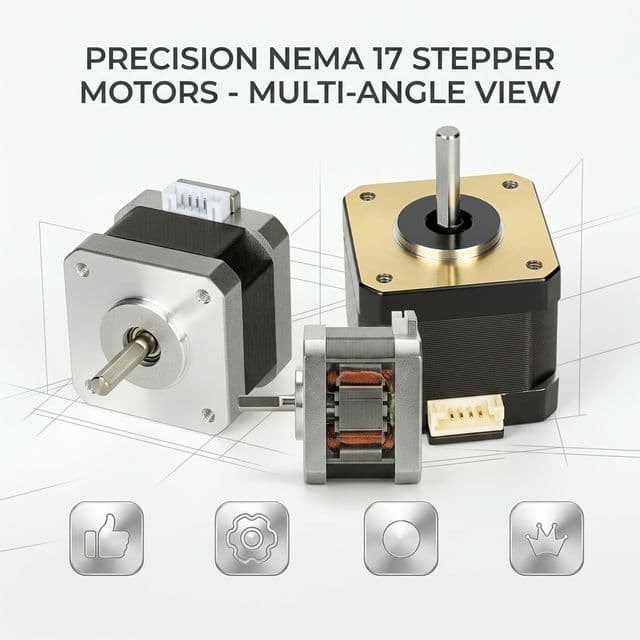
NEMA 17 Integrated Motors: BOM Reduction & TCO Analysis for OEMs
Learn how integrated NEMA 17 stepper motors reduce BOM complexity and TCO for OEMs, with sourcing checks, TCO inputs, and RFQ questions for global buyers.
NEMA 17 OEM RFQ Checklist for Global Buyers
A practical RFQ template to reduce back-and-forth and get faster, accurate quotations for NEMA 17 motor sourcing.
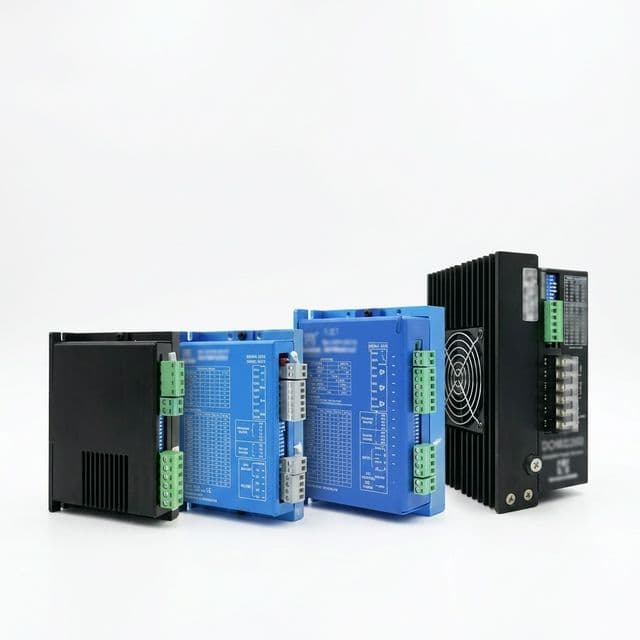
How to Match NEMA 17 Torque, Current, and Driver Settings
A buyer-focused guide to avoid underpowered setups and overheating issues when selecting NEMA 17 motors and drivers.